UK Goods Are Not Exempt from EU CBAM - and Waiting Is Not a Strategy
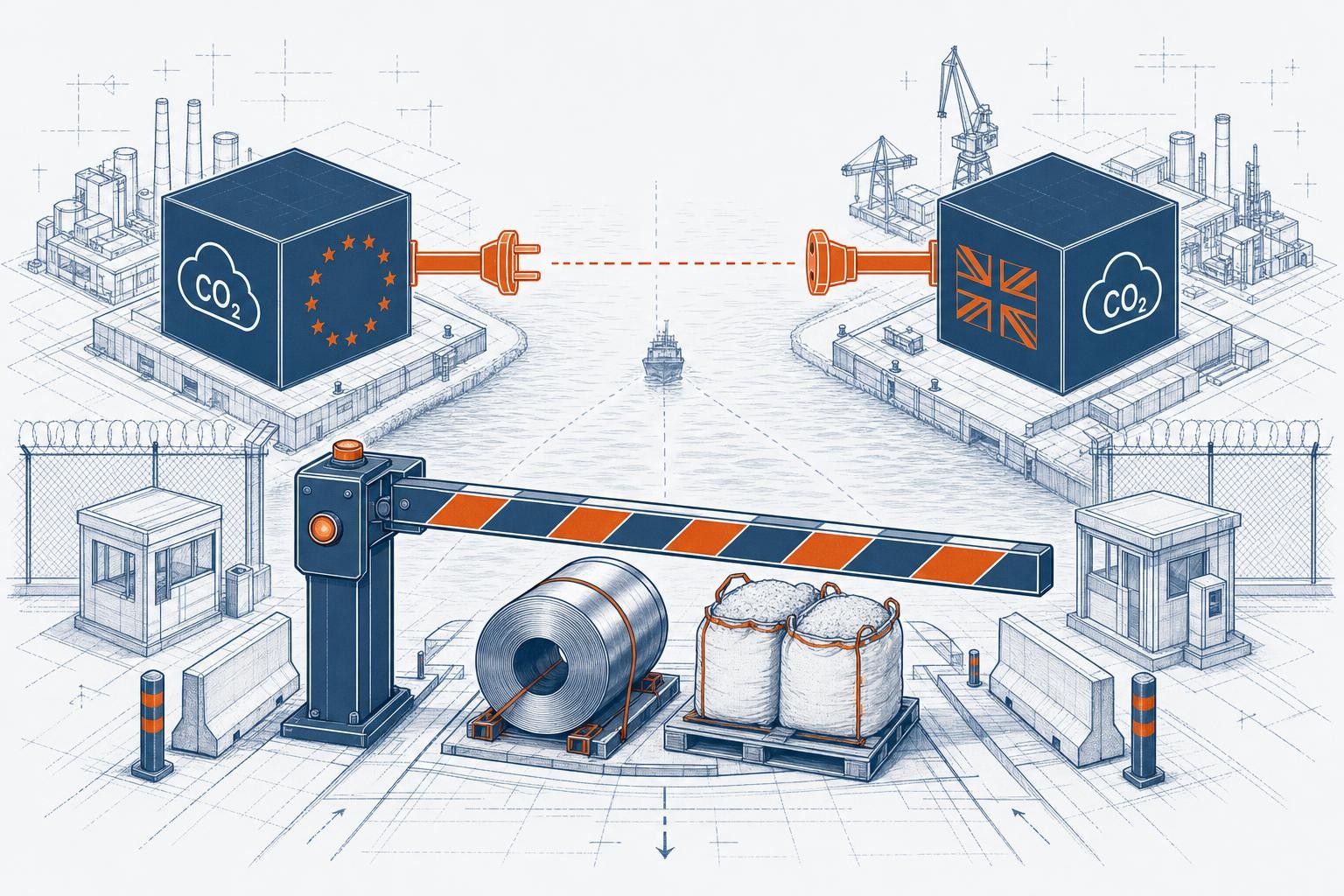
A persistent assumption is circulating in EU procurement teams: the UK has a carbon price, the UK and EU are negotiating ETS linkage, so UK-origin goods are probably about to be exempt from CBAM - or at least treated differently. That assumption is wrong, and acting on it will leave you exposed when the first surrender deadline arrives on 30 September 2027.
This post is written for EU importers and procurement teams buying steel, aluminium, cement, fertilisers, or hydrogen from UK suppliers. It covers where the linkage talks actually stand, what "mutual exemption on linkage" would mean in practice, what you need to do right now, and why UK sourcing still has a genuine commercial argument even without an exemption.
The assumption to kill: "We can wait until linkage is done"
The EU's CBAM entered its fully operational, financially binding phase on 1 January 2026. From that date, UK-origin goods in the six covered sectors - iron and steel, aluminium, cement, fertilisers, hydrogen, and electricity - are ordinary CBAM goods. There is no carve-out, no grace period for near-neighbour countries, and no interim exemption pending the outcome of ETS linkage talks.
CBAM certificates go on sale on 1 February 2027, retroactively covering all 2026 imports, with the first surrender deadline on 30 September 2027. That means the compliance clock for your 2026 UK-origin purchases is already running. The embedded emissions data you need to declare must be collected now, from suppliers who are producing now. You cannot reconstruct it retrospectively.
EU Climate Commissioner Wopke Hoekstra stated the position plainly in December 2025: "We're not exempting anyone, but the moment we will be fully linking those two, it is likely that there will be an exemption at that point in time." The sequencing is unambiguous: linkage first, exemption second, and linkage is not concluded.
If your total annual imports of all CBAM goods combined remain at or below 50 tonnes, you fall within the de minimis threshold and are exempt from CBAM obligations for that year. UK-origin goods count towards that threshold in exactly the same way as goods from any other non-EEA country. Do not assume they are excluded from the count.
Where the linkage negotiations actually stand
The political commitment to link the two systems is genuine and has moved through several concrete steps.
May 2025: At the inaugural EU-UK Summit in London, both sides committed to linking their emissions trading systems as part of the Common Understanding on a Renewed Agenda for Cooperation. The Common Understanding stated that the linking agreement "should create the conditions for mutual exemptions from the respective Carbon Border Adjustment Mechanisms (CBAM), contingent on compliance with relevant legislation." That phrase - contingent on compliance with relevant legislation - matters. The exemption is not automatic on political agreement; it requires implementing legislation on both sides.
November 2025: EU member states unanimously backed a negotiating mandate for the European Commission to open formal ETS linkage talks with the UK on 12 November 2025.
January 2026: On 14 January 2026, Commissioner Hoekstra announced that formal negotiations would begin in the week of 19 January 2026. No deadline for concluding them was set.
Mid-2026: The UK and EU were aiming to announce a formal linkage agreement at a bilateral summit tentatively scheduled for 13 July 2026. That summit was postponed until after the summer. As of the date of this post, the linkage agreement is not yet legally binding, and no confirmed timeline or milestones for conclusion have been published. A July 2026 report from Addleshaw Goddard noted that "negotiations remain ongoing and substantive progress has yet to be achieved, with no confirmed timelines or milestones for their completion."
Industry groups and campaigners have been urging both sides to agree a mutual CBAM exemption to cover the gap between the ETS agreement being signed and entering into force - but that call has not yet produced a formal commitment.
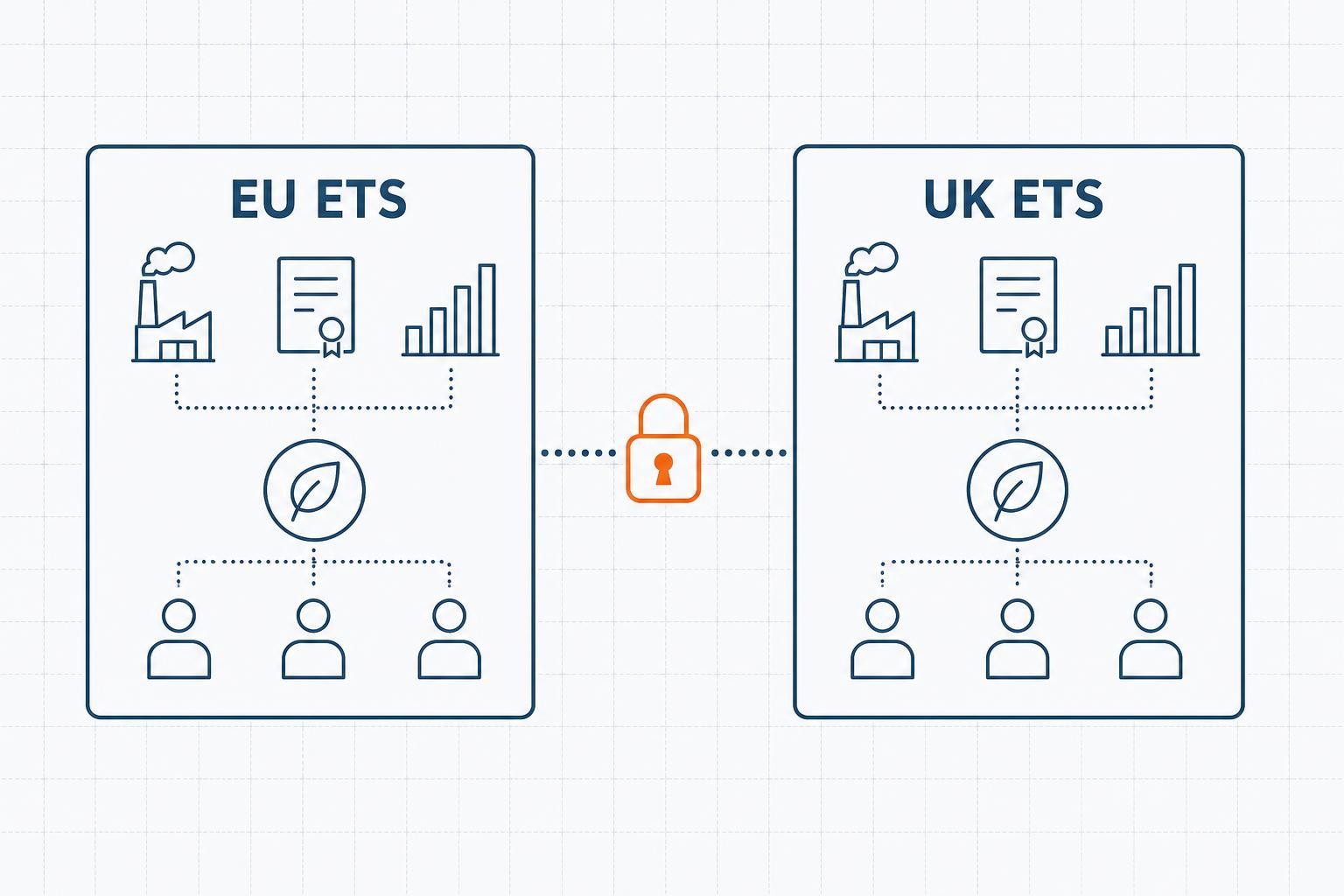
The Switzerland precedent is instructive. Switzerland is currently the only non-EEA country with an emissions trading system formally linked to the EU ETS, and that agreement took several years to negotiate. The EU-UK linkage involves a larger and more complex market, additional sectors, and a parliamentary consent procedure under Article 218 TFEU. Even once a political agreement is reached, it will require approval by the European Parliament and ratification on the UK side before it enters into force.
Bottom line: Plan on the basis that UK goods are standard CBAM goods for the entirety of 2026, and very likely for a significant part of 2027 as well. Nothing published indicates that any exemption, if and when it comes, would apply retroactively to 2026 imports.
What "mutual exemption on linkage" would mean - and what it would not
When linkage is eventually concluded and given legal effect, the intended outcome is that UK-origin goods would no longer require CBAM certificates, in the same way that goods from EU member states, Norway, Iceland, Liechtenstein, and Switzerland do not. That is a meaningful relief.
What it would not do - based on everything published to date - is cancel obligations that arose before the exemption entered into force. The CBAM Regulation applies to goods imported during each compliance year. If you import UK steel in 2026, that import falls within the 2026 compliance year. Nothing in the current legislative framework suggests that a future exemption would extinguish a liability that crystallised under the rules in force at the time of import. Importers should plan on the basis of the rules currently in force, not on the basis of a hoped-for retroactive relief that has not been proposed by either side.
What EU importers of UK-origin goods must do right now
1. Count your threshold exposure
The 50-tonne de minimis threshold is a combined annual figure across all CBAM goods from all origins. If you buy UK steel and also import cement from Turkey, both count. If your combined total stays below 50 tonnes in a calendar year, you are exempt for that year. Above 50 tonnes, full CBAM obligations apply - and the threshold is reviewed annually.
2. Register as an authorised CBAM declarant
Only authorised declarants may import CBAM goods into the EU. If you are not yet registered in the CBAM Registry, that is the first administrative step. Registration is handled through your member state's competent authority.
3. Request embedded emissions data from your UK suppliers
This is the most operationally demanding part, and the one most likely to create friction with UK counterparties who may not yet have their data in order. You need:
- Direct embedded emissions from the production process, verified by an accredited verifier
- Indirect emissions (from electricity used in production) - methodology varies by sector
- Evidence of any carbon price paid under the UK ETS in respect of those specific goods
Default values exist, but they are set conservatively high - based on the worst-performing installations in each sector. For UK steel, which is produced in a market with a genuine domestic carbon price and a relatively decarbonised grid, using default values is likely to mean significant overpayment. Getting actual verified data from your supplier is worth the effort.
4. Claim the UK ETS carbon-price-paid deduction
This is one of the most commercially significant features of UK sourcing under CBAM, and it is underused. If your UK supplier has paid carbon costs under the UK ETS in respect of the goods you are importing, you can deduct the equivalent amount from your CBAM certificate obligation.
The mechanics: your CBAM liability is calculated as embedded tonnes of CO₂ × EU ETS certificate price × the applicable phase-in factor (2.5% in 2026, rising steeply to 100% by 2034). Against that, you can offset the carbon price effectively paid in the country of production. The UK ETS is a qualifying scheme for this purpose. The implementing rules for the deduction were published in draft form by the Commission in May 2026 and are worth reviewing carefully.
We have a dedicated explainer on how to calculate and evidence this deduction: How to Deduct a Carbon Price Already Paid Abroad from Your CBAM Bill. Read that before you finalise your supplier data requests - the evidential requirements are specific.
The commercial read: UK as a comparatively low-CBAM-cost origin
Even without an exemption, UK-origin goods carry a structural advantage over imports from countries with no carbon pricing at all. The logic is straightforward.
The first CBAM certificate price was set at €75.36 per tonne of CO₂e for Q1 2026, reflecting the quarterly average EU ETS auction price. Your CBAM liability is that price multiplied by the embedded emissions intensity of the goods, multiplied by the phase-in factor. Two variables reduce that liability: lower embedded emissions (from cleaner production) and a carbon price already paid in the country of origin.
UK steel producers operate under the UK ETS, which carries a genuine carbon cost. UK electricity generation has a relatively low carbon intensity compared to many competing origins. Both factors work in the same direction: lower embedded emissions and a deductible domestic carbon cost mean a lower net CBAM bill for UK-origin goods compared with, say, goods from a country with no carbon pricing and a coal-heavy grid.
To put numbers on it: according to UK Steel's director for energy and climate change policy, Frank Aaskov, the direct CBAM cost on products such as hot rolled wire was estimated at around €13 per tonne as of December 2025 - against a market price near €650 per tonne. That is a real cost, and in a market where a €5 per tonne difference can determine whether a contract is won or lost, it matters. But compare it with origins where the full default value applies and no carbon price deduction is available: the differential can be substantially larger.
This is not an argument to ignore CBAM on UK goods. It is an argument to quantify it properly rather than assuming it away, and to use the UK ETS deduction mechanism to reduce it as far as the rules allow.
Electricity is a special case. The Commission indicated in December 2025 that UK electricity exports should not in principle be subject to CBAM charges, on the basis that UK generators already face higher carbon costs than EU counterparts. This position was reported in trade press and welcomed by the UK government. However, as of mid-2026, Energy UK was still calling on the Commission to publish formal guidance and address structural issues around electricity CBAM implementation. Treat this as a Commission position under development, not a settled exemption. If you import electricity from the UK via interconnectors, take specific advice on the current position before assuming relief applies.
The 2027 mirror problem
The UK's own CBAM takes effect on 1 January 2027. That creates a one-year asymmetry: throughout 2026, EU CBAM applies to UK goods entering the EU, but no reciprocal UK measure is yet in force on EU goods entering the UK. From 2027, the position reverses for EU exporters selling into the UK.
If you are on the EU side of a supply chain that runs in both directions - selling goods into the UK as well as buying from UK suppliers - you will need to understand both regimes. They are similar in intent but differ in scope, timing, and several design details that affect compliance cost.
We have covered the design differences in detail in The UK CBAM Arrives in 2027: How It Differs from the EU's. This post does not repeat that comparison, but if your procurement team also handles exports to the UK, that post is the companion read.
Your watch list: the triggers that would change this picture
The situation is live. Here are the specific events that would materially alter the compliance picture for EU importers of UK goods:
A formally concluded agreement between the EU and UK — not a political statement of intent, but a signed legal text — is the prerequisite for any CBAM exemption. Watch for an announcement at the next EU-UK summit (expected after summer 2026) and for the text of any agreement, which will specify the conditions and timing of any CBAM relief.
Even after a linkage agreement is signed, a separate implementing act is required to give the CBAM exemption legal effect under Regulation (EU) 2023/956. The May 2025 Common Understanding made clear that exemptions are 'contingent on compliance with relevant legislation.' Monitor the Official Journal of the EU for any amending regulation or delegated act on this point.
The EU-UK linkage agreement requires approval by the European Parliament under Article 218 TFEU. On the UK side, the Finance Act 2026 enacted primary CBAM legislation, but further secondary legislation will be needed to give effect to any mutual exemption. Both processes take time. Energy Aspects, writing in June 2026, expected a gradual convergence over 2027–28 as lawmakers on both sides ratify the deal.
The Commission's December 2025 indication that UK electricity exports should not in principle bear CBAM charges has not yet been codified in a formal implementing act or guidance document. Energy UK, in its June 2026 response to the Commission's carbon price recognition call for evidence, was still urging the Commission to address structural issues around electricity CBAM implementation. Watch for any sector-specific guidance or amendment to the electricity provisions.
The threshold is reviewed annually. Any change — upward or downward — would affect whether smaller importers of UK goods remain within the exemption. Monitor the Commission's annual review publication.
The practical summary
UK goods are CBAM goods. The political direction of travel is towards linkage and mutual exemption, but the road between political commitment and legal effect is long - as the Switzerland precedent illustrates - and nothing published indicates that any future exemption would apply retroactively to 2026 imports.
For EU procurement teams, the immediate actions are: count your threshold exposure, register as an authorised declarant if you have not already done so, request verified emissions data from your UK suppliers, and model the UK ETS carbon-price-paid deduction. That last step in particular is worth doing carefully - it is the mechanism that makes UK sourcing comparatively attractive even in the absence of an exemption.
If you are unsure how to structure your supplier data requests or how to calculate the deduction, we can help.
This post is for informational purposes only and does not constitute legal, tax, or trade advice. The regulations in force govern. Positions described as Commission indications or trade press reports should be verified against official sources before relying on them for compliance decisions.
Related reading
Who Can Actually Accredit Your Supplier's Verifier? Reading the Commission's CBAM Accreditation State-of-Play
The Commission's 25 September accreditation update shows 24 national bodies on board, 15 ready and only 5 taking third-country applications. What that means for suppliers outside the EU and the importers who depend on them.
Norway and Iceland Are Joining CBAM: What the EEA Joint Committee Decisions Change for Importers
On 25 September 2026 the EEA Joint Committee adopted two decisions bringing CBAM to Norway and Iceland. Adoption is not entry into force, though. Here is what is decided, what is pending, and what to watch.
The EU-India Trade Deal Didn't Buy India a CBAM Exemption: What Steel and Aluminium Importers Should Plan For
The EU-India trade agreement cuts tariffs on most goods, but it leaves CBAM untouched. Here is what that means for importers of Indian steel and aluminium, and what to do before the 2026 declaration.