How much will CBAM cost in 2026? The factor ramp, explained
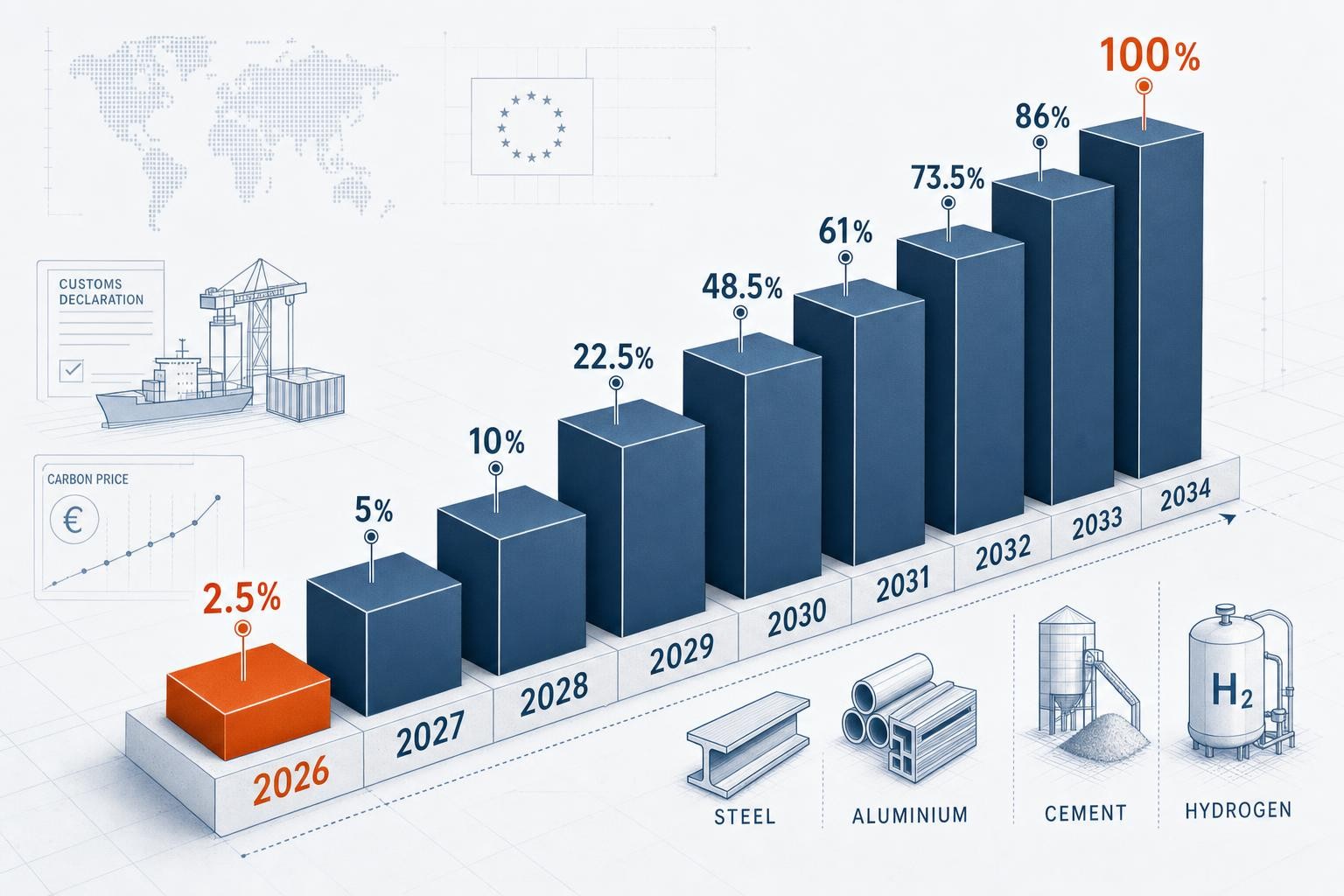
"How much will CBAM cost us?" is the question every finance team eventually asks. The honest answer for 2026 is: less than you might think - for now. Here is the arithmetic.
The formula
A CBAM bill has three moving parts:
CBAM cost ≈ embedded emissions × CBAM factor × certificate price
minus any carbon price you already paid in the country of origin.
Embedded emissions - the tonnes of CO₂e baked into the goods you import, using actual verified data or the Commission's default values.
Certificate price - one certificate covers one tonne of CO₂e. The price tracks the EU ETS auction price; the first published figure, for Q1 2026, was €75.36 per tonne.
CBAM factor - and this is the part that surprises people.
The CBAM factor: why 2026 is cheap
Because EU producers' free ETS allowances are only being withdrawn gradually, you pay CBAM on just a share of your emissions each year. That share - the CBAM factor - ramps up over time:
| Year | CBAM factor |
|---|---|
| 2026 | 2.5% |
| 2027 | 5% |
| 2028 | 10% |
| 2029 | 22.5% |
| 2030 | 48.5% |
| 2034 | 100% |
So in 2026 you effectively pay on 2.5% of your embedded emissions. By 2034, you pay on all of them.
A worked example
Say you import steel with 1,000 tonnes of embedded CO₂e in a year, and the certificate price holds around €75 per tonne:
- 2026: 1,000 × 2.5% × €75 ≈ €1,875
- 2030: 1,000 × 48.5% × €75 ≈ €36,375
- 2034: 1,000 × 100% × €75 ≈ €75,000
Same imports, same price - but a very different bill as the decade goes on. And if ETS prices rise, it climbs higher still.
Plug in your own numbers with our free CBAM cost calculator, which shows your estimate for this year next to the 2030 and 2034 projection.
Two ways to lower the bill
- Use actual values, not defaults. Default values carry a conservative mark-up (around 10% in 2026, rising toward 30% by 2028), so verified installation data from your supplier is usually cheaper. See our default-values reference.
- Claim any carbon price paid abroad. If your supplier's country already charged a carbon price on the goods, you can deduct it - with evidence.
When you actually pay
Not in 2026. For 2026 imports you buy certificates from 1 February 2027 and surrender them by 30 September 2027, alongside your first annual declaration. From 2027 you also hold certificates covering at least 50% of accrued emissions at the end of each quarter. The full timeline is on our CBAM deadlines tracker.
The price method changes to weekly quotes in 2027, and default values are revised periodically. Subscribe to The CBAM Brief for the updates that move the number.
This is plain-English guidance, not legal or tax advice. The official certificate price is published by the European Commission.
Related reading
Who Can Actually Accredit Your Supplier's Verifier? Reading the Commission's CBAM Accreditation State-of-Play
The Commission's 25 September accreditation update shows 24 national bodies on board, 15 ready and only 5 taking third-country applications. What that means for suppliers outside the EU and the importers who depend on them.
Norway and Iceland Are Joining CBAM: What the EEA Joint Committee Decisions Change for Importers
On 25 September 2026 the EEA Joint Committee adopted two decisions bringing CBAM to Norway and Iceland. Adoption is not entry into force, though. Here is what is decided, what is pending, and what to watch.
The EU-India Trade Deal Didn't Buy India a CBAM Exemption: What Steel and Aluminium Importers Should Plan For
The EU-India trade agreement cuts tariffs on most goods, but it leaves CBAM untouched. Here is what that means for importers of Indian steel and aluminium, and what to do before the 2026 declaration.